


– The Ministry of Communication and Information (dubbed “Kominfo”) aims to distribute 60,000 scholarships for digital-related subjects by 2021
 |
JAKARTA, Indonesia, Dec. 4, 2020 /PRNewswire/ — In addition to accelerating national economic recovery in the midst of the Covid-19 pandemic, Indonesia’s government continues to support efforts in improving human capital competitiveness. This is done in order to better prepare them in facing the fourth industrial revolution and able to take advantage of the demographic dividend. This was discussed at a webinar held by the Covid-19 Handling and National Economic Recovery Committee (KPCPEN) titled “Preparing Human Capital Assets to Support Business Recovery in the Pandemic Era,” on Monday (30/11/2020).
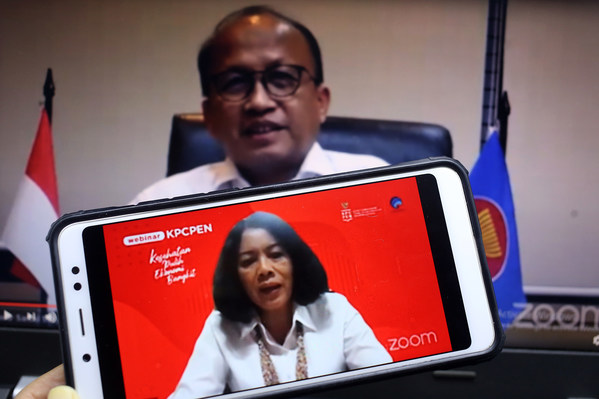
KPCPEN’s Webinar, “Preparing Human Capital Assets to Support Business Recovery in the Pandemic Era.”
Rosarita Niken Widiastuti, Ministry of Communication and Information Special Staff for Information and Public Relations, Digital Transformation and Inter-Agency Relations, said that the government has long prepared various digital tools for Indonesia’s young talents. In 2021, Kominfo is targeting to award 60,000 scholarships for digital-related subjects such as cyber security, cloud computing, big data analysis, artificial intelligence, IOT, robotics and digital business.
“Apart from digital training for micro, small and medium enterprises (MSMEs), Kominfo is holding various digital entrepreneurship trainings or digital talent scholarships. All of these programs’ intention is to prepare the young workforce to face Industry 4.0,” said Rosarita Niken Widiastuti in the webinar.
Moreover, this series of programs has successfully supported nearly five million MSMEs in digital transformation. “We provide support through the ‘grebek pasar’ program, in which the program helps small communities, particularly MSMEs, to sell through online channels. The government does not want the marketplace to be filled only with foreign products,” she said.
Demographic Dividend and Human Capital Competency
In the midst of the Covid-19 pandemic, Indonesia is also facing a demographic bonus which is predicted to last until 2045. This means that the share of the working age-population or the productive workforce is greater than the non-productive share of the population. “In terms of percentage, the productive workforce (16-30 years) almost reaches 25% of the total workforce,” said Anwar Sanusi, Secretary General of the Ministry of Manpower, who was also a speaker at the KPCPEN webinar.
“In the digital society, we must be able to find new business models. Meanwhile, the education and training sectors must be improved,” explained Anwar Sanusi. “Job transformation continues to move forward, and people can now work anywhere and anytime. This trend is accommodated by the Job Creation Law (‘UU Cipta Kerja’) through a wage system based on working hours,” he said.
According to Anwar, the demographic dividend presents both opportunities and challenges. We must be prepared for the transition to Industry 4.0 which focuses a lot on digitization and automation. “In line with the demographic bonus dividend, Indonesia’s human capital is also facing the fourth industrial revolution. Both must be managed optimally.”
One of the webinar speakers, Chairman of Apindo (Employers Association of Indonesia) national board chairman, Hariyadi B. Sukamdani, said “The risks from automation are also quite significant because most of our workforce is in the manufacturing and food sectors. The International Labor Organization (ILO) has predicted that the automotive sector will be severely affected by automation.”
The availability of a large productive workforce often does not get support of a company’s investment in Human Capital competencies. “According to World Bank data, only 4.7% of the total number of companies in Indonesia provide formal training on digitization. So, the problem could very well be about the budget,” said Sukamdani.
According to him, the government must focus more on utilizing the apprenticeship program and ‘Balai Latihan Kerja’/BLK (Vocational training center). Thus, our human capital would have competent qualifications, and are ready to dive into the business environment. “Moving forward, entrepreneurs hope that BLK can be a useful means of improving the skills of the workforce.”
About KPCPEN
Based on the consideration that the handling of Coronavirus Disease 2019 (Covid-19) and the national economy recovery must be aligned in one integrated and inseparable strategic policy, President Joko Widodo issued Presidential Regulation (Perpres) No. 82 of 2020 on the Covid-19 Handling and National Economic Recovery Committee (KPCPEN) signed on July 20 2020.
The KPCPEN priorities respectively are INDONESIA SEHAT (Priority for people to be safe from Covid-19 and reforming health services), INDONESIA BEKERJA (Priority for empowerment and acceleration of employment), INDONESIA TUMBUH (Priority for national economy recovery and transformation).
Media Contact:
Communication Team of the Covid-19 Handling and National Economic Recovery Committee (KPCPEN)
Lalu Hamdani 081284519595 / 081212865928
Email: media-kpcpen@covid19.go.id
Donate To The Indian Sun
Dear Reader,The Indian Sun is an independent organisation committed to community journalism. We have, through the years, been able to reach a wide audience especially with the growth of social media, where we also have a strong presence. With platforms such as YouTube videos, we have been able to engage in different forms of storytelling. However, the past few years, like many media organisations around the world, it has not been an easy path. We have a greater challenge. We believe community journalism is very important for a multicultural country like Australia. We’re not able to do everything, but we aim for some of the most interesting stories and journalism of quality. We call upon readers like you to support us and make any contribution. Do make a DONATION NOW so we can continue with the volume and quality journalism that we are able to practice.
Thank you for your support.
Best wishes,
Team The Indian Sun


