


 |
- Channeling a total of Rp 3.6 trillion in aid to two million people.
- Beneficiaries include lecturers at state and private universities, teachers, as well as library, laboratory and administrative staff who all receive a lump sum of Rp 1.8 million each.
JAKARTA, Indonesia, Nov. 25, 2020 /PRNewswire/ — The Ministry of Education and Culture together with the Covid-19 Handling and National Economic Recovery Committee (KPCPEN) and the Ministry of Finance launched the “Bantuan Subsidi Upah” (BSU/wage subsidy) program. With a total budget of Rp 3.6 trillion, BSU targets two million PTK (Non-Civil Servant Educators and Educational Personnel) within the Ministry of Education and Culture (Kemendikbud). In turn, the government is helping to improve the welfare of non-civil servant educators and educational workers in the midst of the Covid-19 pandemic.
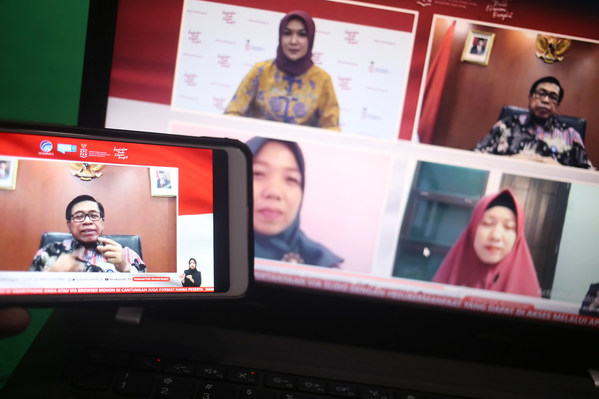
Interactive Dialogue “Wage Subsidy to Support Non-Civil Servant Educators and Educational Personnel”.
This was conveyed by Dr. Abdul Kahar, Head of the Ministry of Education and Culture’s Education Financial Service Center, in an interactive dialogue event titled “Wage Subsidy to Support Non-Civil Servant Educators and Educational Personnel” at the KPCPEN Media Center on Thursday (19/11/2020).
“BSU is a subsidy plan for teachers with short-term contracts (honorer), particularly those that are non-civil servants. We are very aware that the public, especially educators and education personnel (PTK), are being affected by the Covid-19 pandemic,” says Dr. Abdul Kahar.
BSU is channeled to 162,000 lecturers of state and private universities, 1.6 million teachers and educators in public and private education institutions, as well as 237,000 library, laboratory and administrative staff. The BSU amount received by each PTK is a lump sum of Rp 1.8 million.
“We refer to the Disnaker (Local government Manpower department) BSU program. Previously, the recorded aid that was launched was Rp 600,000 per month. However, at the Disnaker level, the value of the aid was multiplied by four months so that the total value reaches Rp 2.4 million. Since the Ministry of Education and Culture has just started the BSU program, then the value is only multiplied by three months. That is why, the amount of BSU received is Rp 1.8 million,” Kahar explained.
Easier Eligibility Criteria
The requirements for PTK to apply for BSU are very simple: an Indonesian citizen (WNI), earning less than Rp 5 million per month, and their status is a non-civil servant; does not receive wage/salary subsidy aid from the Ministry of Manpower and are not recipients of the “Kartu Prakerja” (Pre-Employment Card program) up until October 1, 2020.
“Actually, we only target these three groups. In the next phase, we evaluate its administration, including by checking that the applicants for the BSU have been registered at the Info GTK and PDDikti (websites),” said the Kemendikbud official.
“The wage subsidy has been distributed since November 16. We immediately distributed the program because the data was readily available. So, we didn’t have to wait for data from the ground. We just needed to match the data with the BPJS (Social security) and ‘Kartu Prakerja’ (Pre-employment card program) data,” Kahar explained. The Ministry of Education and Culture have set a target of the end of November 2020 to complete the BSU aid disbursement.
The terms for collecting BSU funds are also very easy. Beneficiaries only need to bring their National ID and Tax ID (KTP, NPWP, if any), then download the SK (Letter of assignment document) at the Info GTK or PDDikti (websites), and sign the SPTJM (Statement of Responsibility Letter). After completing the entire process, beneficiaries will be given time to activate their accounts until June 31 2021 to collect their Rp 1.8 million before-tax.
“Hopefully our data is valid. Moreover, we have validated them by matching the data through the BPJS Ketenagakerjaan (Social security provider) and the Kartu Prakerja (Pre-employment card) program. We are ever more convinced that our data does not overlap with each other, especially after doing some coordination for these data,” Kahar explained.
He also added that the local government education department will immediately update the data if there are potential beneficiaries who meet the requirements but have not been registered. “Of course, we saw that the data was registered on July 30th. However, we will not input new data,” he concluded.
About KPCPEN
Based on the consideration that the handling of Coronavirus Disease 2019 (Covid-19) and the national economy recovery must be aligned in one integrated and inseparable strategic policy, President Joko Widodo issued Presidential Regulation (Perpres) No. 82 of 2020 on the Covid-19 Handling and National Economic Recovery Committee (KPCPEN) signed on July 20 2020.
The KPCPEN priorities respectively are INDONESIA SEHAT (Priority for people to be safe from Covid-19 and reforming health services), INDONESIA BEKERJA (Priority for empowerment and acceleration of employment), INDONESIA TUMBUH (Priority for national economy recovery and transformation).
Media Contact:
Communication Team of the Covid-19 Handling and National Economic Recovery Committee (KPCPEN)
Lalu Hamdani 081284519595 / 081212865928
Email: media-kpcpen@covid19.go.id

Support Independent Community Journalism
Dear Reader,The Indian Sun exists for one reason: to tell stories that might otherwise go unheard.
We report on local councils, state politics, small businesses and cultural festivals. We focus on the Indian diaspora and the wider multicultural community with care, balance and accountability. We publish in print and online, send regular newsletters and produce video content. We also run media training programs to help community organisations share their own stories.
We operate independently.
Community journalism does not have the backing of large media corporations. Advertising revenue fluctuates. Platform algorithms change. Costs continue to rise. Yet the need for credible, grounded reporting in a multicultural Australia has never been greater.
When you support The Indian Sun, you support:
• Independent reporting on issues affecting migrant communities
• Coverage of local and state decisions that shape daily life
• A platform for small businesses and community groups
• Media training that builds skills within the community
• Journalism accountable to readers
We cannot cover everything, but we work to cover what matters.
If you value thoughtful reporting that reflects Australia’s diversity, we invite you to contribute. Every donation helps us maintain the quality and consistency of our work.
Please consider making a contribution today.
Thank you for your support.
The Indian Sun Team


