

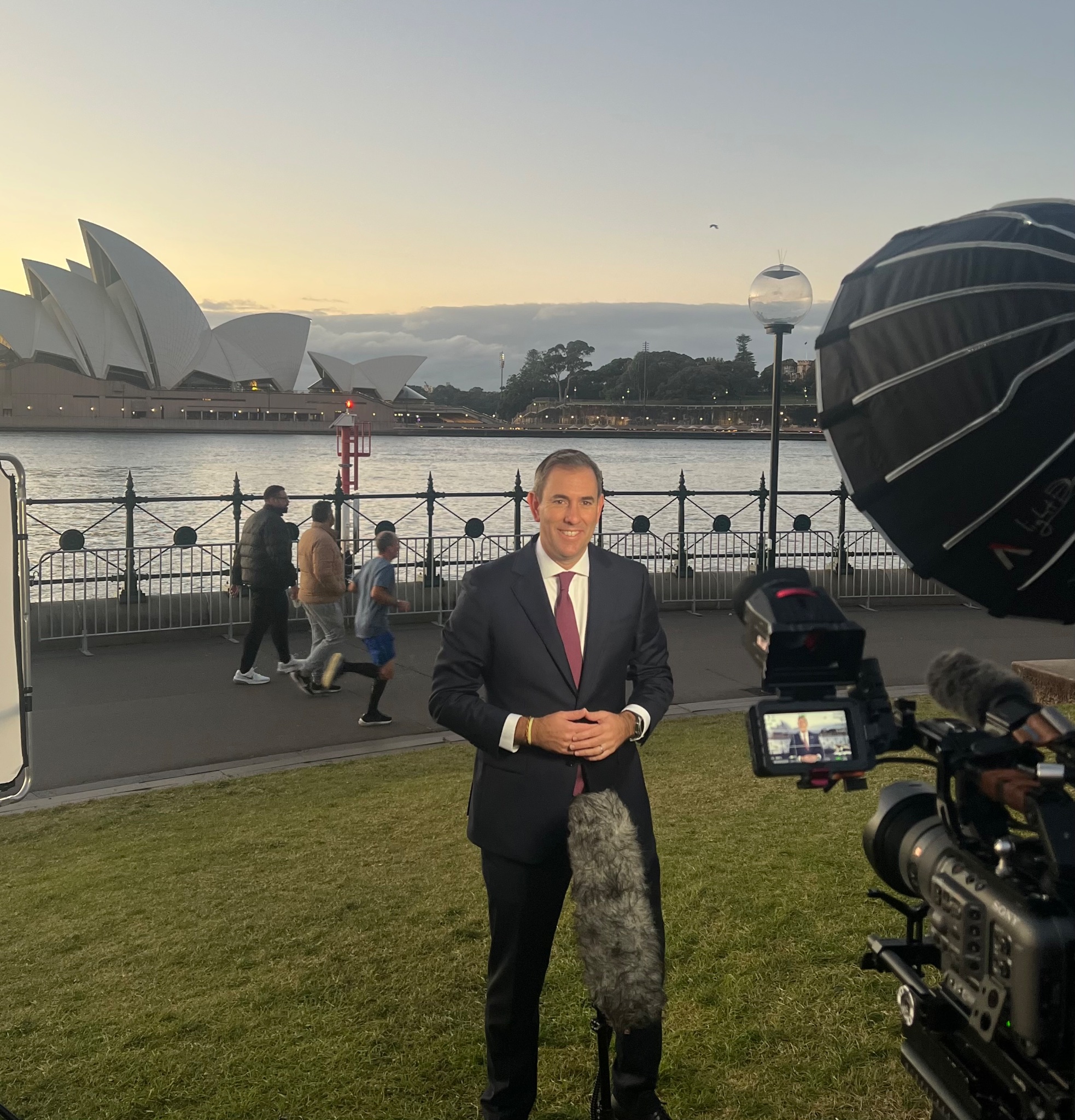
The Reserve Bank of Australia (RBA) has decided to maintain the official interest rates at 4.35 per cent, a move welcomed amidst global financial turbulence. The last adjustment was made in November last year.
Treasurer Jim Chalmers addressed the media following the RBA’s announcement. He highlighted the decision’s importance in the face of persistent inflation and substantial uncertainty regarding the economic outlook. The RBA noted that inflation remains a challenge but recognised the progress made in recent months.
Chalmers acknowledged the economic difficulties faced by Australians, emphasising that the decision to hold rates provides some relief to mortgage holders and small businesses already under pressure. “I think people are doing it tough enough as it is. The last thing they need is more cost-of-living pressure,” Chalmers said. He pointed out that global market volatility, driven by weaker-than-expected jobs growth and tech earnings in the US, as well as rising interest rates in Japan, has had an impact on the Australian dollar and local share markets.
The Treasurer stressed the importance of responsible economic management, especially given the current global economic conditions. “There is global economic uncertainty, and the economic conditions are soft, and that’s why we saw the decision that we saw yesterday,” Chalmers noted. He added that the annual trimmed mean inflation has moderated for six consecutive quarters, and while headline inflation is more persistent, it is now less than half its peak and significantly lower than the 6.1 per cent inherited at the last election.
Chalmers assured that the government’s cost-of-living measures are expected to reduce headline inflation to below 3 per cent in the next year. He also mentioned that the Albanese Labor Government is rolling out substantial cost-of-living relief, which has already taken half a percentage point off inflation, according to recent ABS data. “What the ABS has shown in recent inflation data is that the way that we’re delivering our cost-of-living help is pushing downward pressure on inflation, and that is our objective,” he stated.
The Treasurer highlighted the delivery of the first back-to-back surpluses in almost two decades, which the RBA Governor acknowledged as aiding the fight against inflation. “We’ve already made some difficult decisions to manage the infrastructure pipeline. We’ve done that in previous budgets to make sure that the commitments that we’ve made on infrastructure can actually be built,” Chalmers explained. He reiterated that the government’s economic plan focuses on fighting inflation and easing cost-of-living pressures without adversely affecting the economy. “Inflation would be higher without our efforts in the budget,” he asserted.
Chalmers responded to criticisms regarding government spending and its impact on inflation. “Budget spending is not the primary determinant of prices in the economy, but we can be helpful, and we are being helpful, with the design of our cost-of-living policies which help us get back to targets sooner,” he argued.
On the housing and infrastructure front, Chalmers acknowledged the challenges but emphasised ongoing efforts to address them. “The pipeline is not what we need it to be. The two numbers in the inflation figures which are relevant here, and I’m doing this from memory, so forgive me if they’re not kind of exactly right to the decimal point, but the construction part of the CPI was about 5.1 per cent in the most recent data. That is too high, and it’s been high for a while now, and that’s obviously a big challenge, given that’s a big component of the CPI. The second number which really matters is that rent is running at 7.3 per cent. So, the things that we need to do there and the things we are doing is rent would have been 9.1 per cent where it wasn’t for our commonwealth rent assistance,” he elaborated.
Yesterday’s decision by the RBA, on August 6th, in the context of a volatile global economic environment, underscores the importance of vigilance and proactive economic management. The focus remains on achieving a soft landing for the economy while providing necessary relief to those most affected by current economic challenges.
Quotes from E&OE Transcript, Radio Interview, ABC RN Breakfast, Wednesday, 7 August 2024.
Support independent community journalism. Support The Indian Sun.

Follow The Indian Sun on Twitter | Instagram | Facebook

Support Independent Community Journalism
Dear Reader,The Indian Sun exists for one reason: to tell stories that might otherwise go unheard.
We report on local councils, state politics, small businesses and cultural festivals. We focus on the Indian diaspora and the wider multicultural community with care, balance and accountability. We publish in print and online, send regular newsletters and produce video content. We also run media training programs to help community organisations share their own stories.
We operate independently.
Community journalism does not have the backing of large media corporations. Advertising revenue fluctuates. Platform algorithms change. Costs continue to rise. Yet the need for credible, grounded reporting in a multicultural Australia has never been greater.
When you support The Indian Sun, you support:
• Independent reporting on issues affecting migrant communities
• Coverage of local and state decisions that shape daily life
• A platform for small businesses and community groups
• Media training that builds skills within the community
• Journalism accountable to readers
We cannot cover everything, but we work to cover what matters.
If you value thoughtful reporting that reflects Australia’s diversity, we invite you to contribute. Every donation helps us maintain the quality and consistency of our work.
Please consider making a contribution today.
Thank you for your support.
The Indian Sun Team


