


BARCELONA, Spain, Nov. 18, 2021 /PRNewswire/ — World experts in digital processing and the socio-economic impact of major technological changes call for urgent progress and concrete actions to ensure the protection and promotion of people’s rights in this area and not just well-intended speeches. As they did so during the event “Humanism in the digital age: the urban contribution“, organised by Digital Future Society and the City Council of Barcelona, where 150 entities and 40 top-level international speakers took part. The highly positive feedback received during the event strengthens Barcelona as a leading technological human-centered perspective globally.
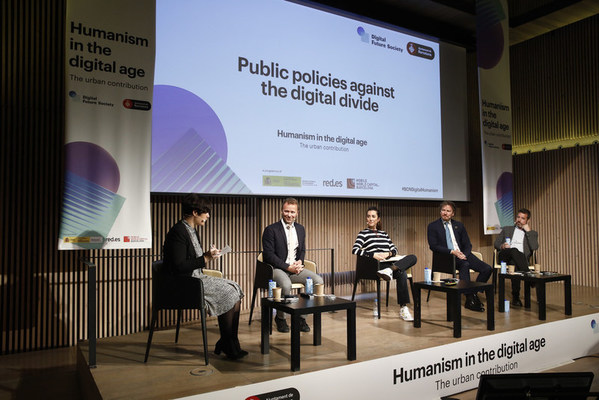
The digital humanism event gathered 40 international speakers in Barcelona
Digital Future Society’s director, Cristina Colom, inaugurated the event encouraging a call to action: “We need to shift some of our priorities to focus on some key social pressing challenges. The way we tackle these challenges, the way we seek solutions, the way we foster international cooperation, will determine the digital future, will determine our digital future.”
By her side, the writer and philosopher of the Institute of Ethics at the IA at Oxford University, Carissa Véliz, emphasises the right to data protection and control: “our democracy is at stake.”
Another session focused on the use of data as a fight against digital divides. The New York CTO, John Paul Farmer, opts for a strategy that considers access, connectivity, infrastructure, and affordability, since “tech is not a luxury, rather a necessity and connectivity must be universal.” The Director of ONTSI, Lucía Velasco, points out the growing digital frustration by stressing that “we ask citizens to interact with digital administrations regardless of users and their experience or access.”
The Executive Director Alliance for Affordable Internet, Sonia Jorge, shifted her attention on gender divides, stating that “The world has missed out an opportunity of $1 billion for not including girls in digital societies.” Also, Núria Oliver of the Data-Pop Alliance reflects on the lack of STEM women: “Any field lacking in diversity will not unlock its full potential and solutions will never be fully inclusive.”
Regarding facial recognition in cities, the European Digital Rights Initiative advisor Sarah Chander states, “We need to understand human risk, who will be impacted, how and why.” Similarly, the rapporteur and AI Act, Brando Benifei encourages the European Parliament to “declare a clear position” on this technology, as the regulation continues “having many interpretations.” In the same vein, the researcher on Human Rights Watch, Amos Toh points out the need to “empower citizens to understand how technology is designed and its limits.”
To address the regulation of AI, the cabinet member of the Vice-President of the European Commission, Werner Stengg, recalls that “AI is not necessarily the enemy of technological innovation.” For her part, the COE of Open Knowledge Foundation, Renata Ávila, stresses that privacy should “be default, but it’s not enough, we need other values like open innovation.”
The act concluded with the intervention of the CEO of Mobile World Capital Barcelona, Carlos Grau, who committed himself to “working together and fostering cooperation between all key actors.”
Media Contact: Emily Henley ehenley@tinkle.es, +34 661 267 495

Support Independent Community Journalism
Dear Reader,The Indian Sun exists for one reason: to tell stories that might otherwise go unheard.
We report on local councils, state politics, small businesses and cultural festivals. We focus on the Indian diaspora and the wider multicultural community with care, balance and accountability. We publish in print and online, send regular newsletters and produce video content. We also run media training programs to help community organisations share their own stories.
We operate independently.
Community journalism does not have the backing of large media corporations. Advertising revenue fluctuates. Platform algorithms change. Costs continue to rise. Yet the need for credible, grounded reporting in a multicultural Australia has never been greater.
When you support The Indian Sun, you support:
• Independent reporting on issues affecting migrant communities
• Coverage of local and state decisions that shape daily life
• A platform for small businesses and community groups
• Media training that builds skills within the community
• Journalism accountable to readers
We cannot cover everything, but we work to cover what matters.
If you value thoughtful reporting that reflects Australia’s diversity, we invite you to contribute. Every donation helps us maintain the quality and consistency of our work.
Please consider making a contribution today.
Thank you for your support.
The Indian Sun Team


