


 |
- Discipline in adhering to health protocols is a shared responsibility
JAKARTA, Indonesia, Nov. 27, 2020 /PRNewswire/ — All parties must adhere to health protocols as best they can in order to keep the Covid-19 transmission low. In addition, everyone must always maintain a strong immune system so the public at large would be resilient in the midst of the current pandemic. This was conveyed by dr. Twindy Rarasati, a Covid-19 survivor, in the “Dialog Produktif” program titled “Vaccines as part of Preventive Health Planning” held at The Covid-19 Handling and National Economic Recovery Committee (KPCPEN) Media Center on Monday (23/11).
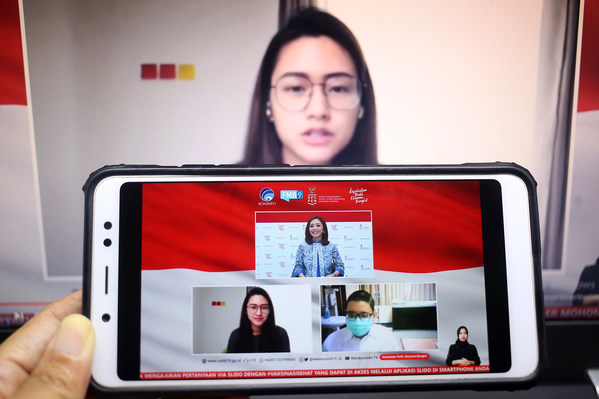
Productive Dialogue: Vaccines as Health Preventive Planning.
Twindy, like all other health workers, faces greater risks of contracting Covid-19 than the general public. After undergoing a series of examinations, she had tested positive for Covid-19. “At first, I felt short of breath, then I had headaches, fatigue, as well as lost my sense of smell and taste. But I didn’t have a fever or cough though,” she explained.
She believes that there are many symptoms that can appear when a person is infected with SARS CoV-2. That is why Twindy recommends that everyone should always pay attention to the changes that occur in their bodies. “I was hospitalized for two weeks and went into self-isolation for another two weeks at home. After that, I was declared as recovered from Covid-19 and could return to work,” said Twindy.
Boost Immunity
Twindy explained that during the recovery process her sense of taste and smell gradually recovered after losing both of those senses for four or five days. “I arranged for my dietary intake to be high calorie and high protein. This was an effort to boost immunity,” she said when sharing about the treatment that she went through.
Because of her profession as a doctor and being at the forefront, Twindy realizes that she faces a greater risk of contracting Covid-19 than the general public. In order to prevent the risk of transmission, Twindy’s initiative is to mitigate the risks. “I have implemented health protocols at home. There is a separate room and there is already a flow to the things we have to do when we get home. Eating meals are not done together to reduce the risk of transmission to other family members,” she said.
Based on her experience as a survivor, Twindy said that health protocols must be adhered to as best as possible. “The responsibility to carry out health protocols lies with us. Don’t forget to continuously update the knowledge related to Covid-19 so we know what we must do during this Covid-19 pandemic. For now, we must continue to fight against Covid-19 and keep our spirits up. We can rise up and overcome this pandemic,” she concluded.
About KPCPEN
Based on the consideration that the handling of Coronavirus Disease 2019 (COVID-19) and the national economy recovery must be aligned in one integrated and inseparable strategic policy, President Joko Widodo issued Presidential Regulation (Perpres) No. 82 of 2020 on the Covid-19 Handling and National Economic Recovery Committee (KPCPEN) signed on July 20 2020.
The KPCPEN priorities respectively are INDONESIA SEHAT (Priority for people to be safe from COVID-19 and reforming health services), INDONESIA BEKERJA (Priority for empowerment and acceleration of employment), INDONESIA TUMBUH (Priority for national economy recovery and transformation).
Media Contact:
Communication Team of the Covid-19 Handling and National Economic Recovery Committee (KPCPEN)
Lalu Hamdani
081284519595 / 081212865928
Email: media-kpcpen@covid19.go.id

Support Independent Community Journalism
Dear Reader,The Indian Sun exists for one reason: to tell stories that might otherwise go unheard.
We report on local councils, state politics, small businesses and cultural festivals. We focus on the Indian diaspora and the wider multicultural community with care, balance and accountability. We publish in print and online, send regular newsletters and produce video content. We also run media training programs to help community organisations share their own stories.
We operate independently.
Community journalism does not have the backing of large media corporations. Advertising revenue fluctuates. Platform algorithms change. Costs continue to rise. Yet the need for credible, grounded reporting in a multicultural Australia has never been greater.
When you support The Indian Sun, you support:
• Independent reporting on issues affecting migrant communities
• Coverage of local and state decisions that shape daily life
• A platform for small businesses and community groups
• Media training that builds skills within the community
• Journalism accountable to readers
We cannot cover everything, but we work to cover what matters.
If you value thoughtful reporting that reflects Australia’s diversity, we invite you to contribute. Every donation helps us maintain the quality and consistency of our work.
Please consider making a contribution today.
Thank you for your support.
The Indian Sun Team


