


Australia’s job market is showing a mix of positive and challenging trends, according to the latest data for the June 2024 quarter. While sectors like health care, construction, and professional services are powering ahead in terms of hours worked, self-employed Australians are feeling the pinch as financial pressures continue to mount. This contrast highlights both growth and strain as the economy continues its recovery.
According to the Australian Bureau of Statistics (ABS), total hours worked in the economy surged by 1.1% in the June quarter, reaching an impressive 5.9 billion hours. This increase was largely driven by the healthcare sector, Australia’s largest employer, alongside construction and professional services. These three industries have been instrumental in absorbing demand post-pandemic, but not all sectors are experiencing the same growth.
Despite the increase in overall working hours, the income for self-employed Australians fell by 2%, a clear sign that independent contractors and small business owners are grappling with tougher market conditions. This decline in income, while employment in some key industries rises, suggests deeper issues related to operational costs, competition, and fluctuating demand in certain sectors. Small business insolvencies have also surged, with 793 business-related personal insolvencies reported in the June quarter alone. Rising input costs, slower revenue growth, and cash flow constraints are just a few reasons why small enterprises might be struggling.
This trend isn’t isolated. Recent reports from ASIC show that overall company failures have spiked by 36.2%, driven in large part by construction, retail, and hospitality sectors, all of which have been hit hard by fluctuating demand and increased costs. Construction, in particular, saw a 0.5% decrease in total jobs, reflecting a slowdown in building projects as materials and labour costs surge. Additionally, industries such as arts and recreation services have reported an 8.5% decline in jobs, further highlighting an uneven recovery across sectors.
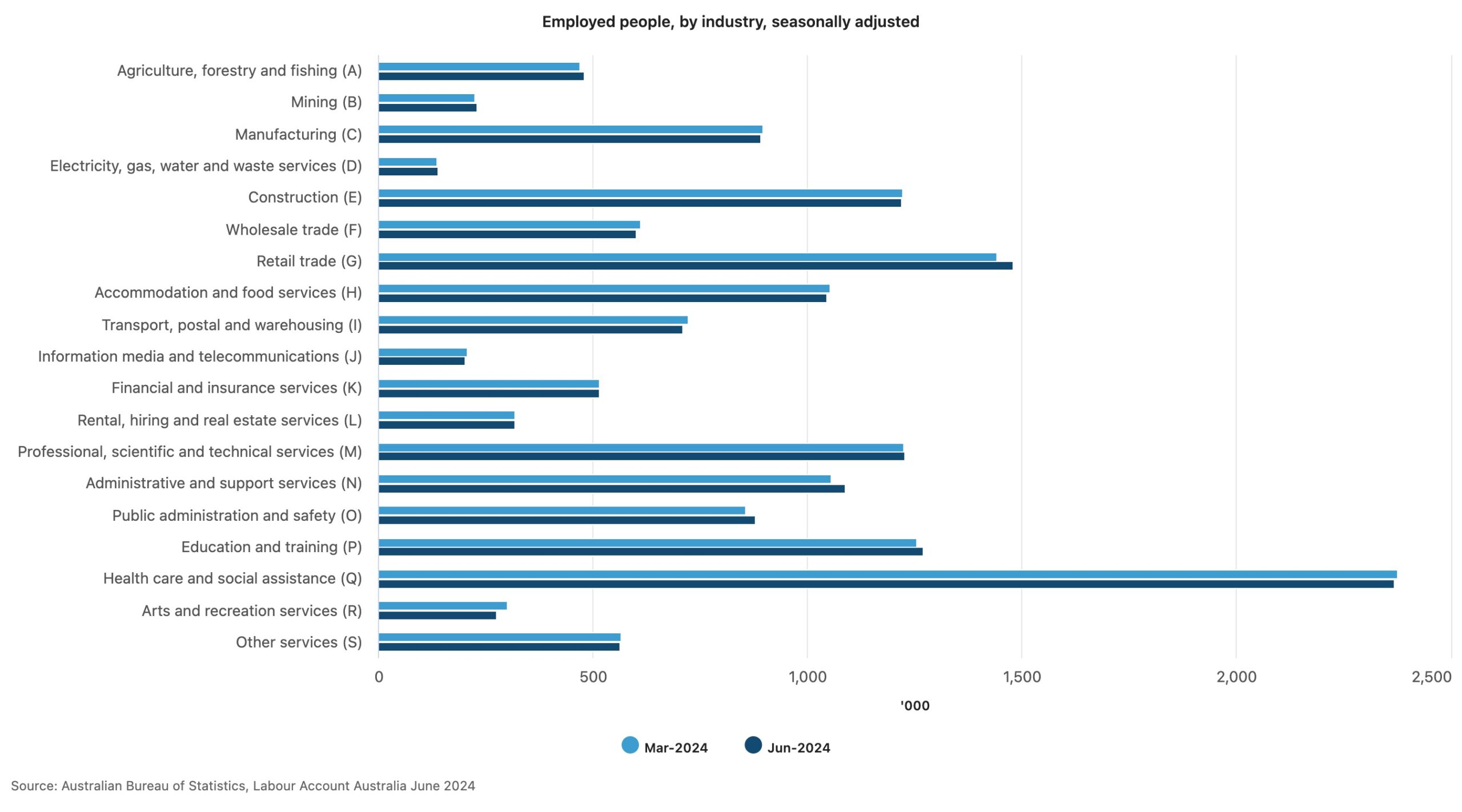
On the flip side, the data shows a bright spot in employment. The total number of jobs grew by 0.3%, with 16.1 million jobs recorded in Australia. Filled jobs increased by 0.4% to 15.8 million, demonstrating that the labour market continues to expand, though at a slower pace compared to previous quarters. The number of Australians holding multiple jobs also declined by 1.2%, which could indicate that more Australians are finding security in their primary jobs. However, unemployment also ticked up, with an additional 22,600 people joining the jobless ranks, bringing the total unemployed to 599,300.
A deeper look into the industry-specific data shows some interesting trends. Mining continues to perform strongly, with a 2.4% growth in filled jobs, largely driven by strong global demand for Australian resources. Meanwhile, retail trade saw job growth of 2.6%, reflecting consumer spending patterns that have remained relatively strong despite inflationary pressures. However, manufacturing and accommodation and food services saw declines in jobs, with accommodation dropping by 7.8%, indicative of a cooling in tourism and related sectors.
While more Australians are working longer hours, the real challenge lies in wage stagnation. The average income per employed person edged up by only 0.1% to $23,791, suggesting that wage growth remains stubbornly slow, despite the increase in job opportunities. This raises concerns about real wages, as inflationary pressures continue to impact household purchasing power. Moreover, small businesses, already struggling to maintain cash flow, are likely feeling the squeeze as costs rise without a proportional increase in income.
Although the data shows some positives, those hoping for an interest rate cut may be disappointed. The economy continues to display resilience, which could prompt the RBA to stay its course on monetary policy rather than opt for rate reductions anytime soon.
Support independent community journalism. Support The Indian Sun.

Follow The Indian Sun on X | Instagram | Facebook

Support Independent Community Journalism
Dear Reader,The Indian Sun exists for one reason: to tell stories that might otherwise go unheard.
We report on local councils, state politics, small businesses and cultural festivals. We focus on the Indian diaspora and the wider multicultural community with care, balance and accountability. We publish in print and online, send regular newsletters and produce video content. We also run media training programs to help community organisations share their own stories.
We operate independently.
Community journalism does not have the backing of large media corporations. Advertising revenue fluctuates. Platform algorithms change. Costs continue to rise. Yet the need for credible, grounded reporting in a multicultural Australia has never been greater.
When you support The Indian Sun, you support:
• Independent reporting on issues affecting migrant communities
• Coverage of local and state decisions that shape daily life
• A platform for small businesses and community groups
• Media training that builds skills within the community
• Journalism accountable to readers
We cannot cover everything, but we work to cover what matters.
If you value thoughtful reporting that reflects Australia’s diversity, we invite you to contribute. Every donation helps us maintain the quality and consistency of our work.
Please consider making a contribution today.
Thank you for your support.
The Indian Sun Team


