


SINGAPORE, Nov. 25, 2020 /PRNewswire/ — Model-based development (MBD), a method of testing complicated interactions among software as a simulated system using virtual recreations of mechanics, is becoming increasingly popular within the manufacturing sector, especially the automotive industry. Find out how Toshiba is applying a cyber-physical approach to MBD to help organisations build transformative and sustainable solutions for cost and productivity efficiencies.
For the full multimedia release, click here: https://www.prnasia.com/mnr/toshiba_202011.shtml
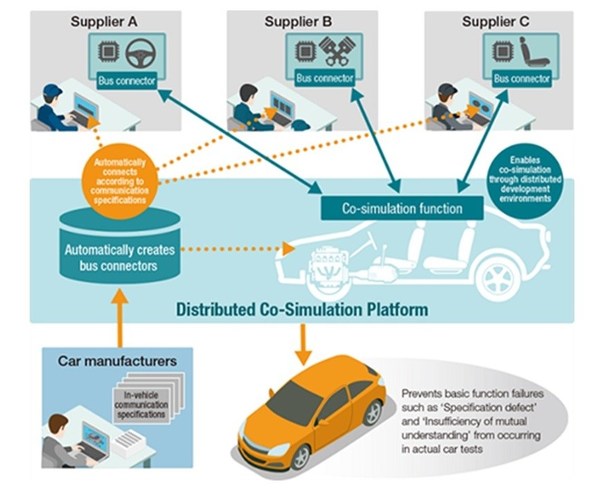
Schematic of the Distributed Co-Simulation Platform
A cyber-physical era of model-based development
While MBD is effective in testing the efficiency of individual components, it struggles to keep pace with the interconnectivity of today’s cars following the arrival of numerous different types of electronic components and systems within the CASE (i.e. the development of Connected, Autonomous, Shared and Electric vehicles) fields – all of which need to be able to work together.
Toshiba’s Distributed Co-Simulation Platform, with its cyber-physical approach, has the potential to revolutionise what can be achieved, and subsequently simplify these challenges facing automotive companies today. Cyber-physical systems (CPS) are defined as those which collect real-world data and analyse it within cyber or digital environments – using technologies like Artificial Intelligence (AI) – before then applying the learnings back within the physical world to create added value.
By deploying a CPS approach to MBD, Toshiba’s platform has essentially evolved this technique to a new level of large-scale simulations which connect multiple models – owned by different automakers and parts suppliers – within a single digital testing environment.
The solution allows automakers to build a fully virtual prototype of the car, enabling them to perform the necessary verifications of today’s complex automotive control systems much earlier in the process – and in turn, significantly improve quality and productivity. Connections between different suppliers can be automated to reduce man-hours, while simulations can be executed via the cloud to reduce latency and considerably accelerate the wider verification process.
A joint approach to techniques such as model-based development may be a first step, but as the physical and digital worlds continue to converge, we will undoubtedly see the emergence of more cyber-physical systems transform the way in which we work and live across multiple domains.
Donate To The Indian Sun
Dear Reader,The Indian Sun is an independent organisation committed to community journalism. We have, through the years, been able to reach a wide audience especially with the growth of social media, where we also have a strong presence. With platforms such as YouTube videos, we have been able to engage in different forms of storytelling. However, the past few years, like many media organisations around the world, it has not been an easy path. We have a greater challenge. We believe community journalism is very important for a multicultural country like Australia. We’re not able to do everything, but we aim for some of the most interesting stories and journalism of quality. We call upon readers like you to support us and make any contribution. Do make a DONATION NOW so we can continue with the volume and quality journalism that we are able to practice.
Thank you for your support.
Best wishes,
Team The Indian Sun


